

It’s 2026; people no longer want to manually search for flights, products, or restaurant tables. They want these tasks executed with the current AI assistants on their behalf. As a result, it has caused a major shift in the SEO landscape!
That’s why, with the help of WebMCP, Google & Microsoft are trying to reshape how we use the web. And it’s not something that you can ignore as a website owner.
With that said, I have thoroughly discussed the rise of WebMCP and SEO Implications in 2026 in this article.
Let’s dive in.
What is WebMCP?
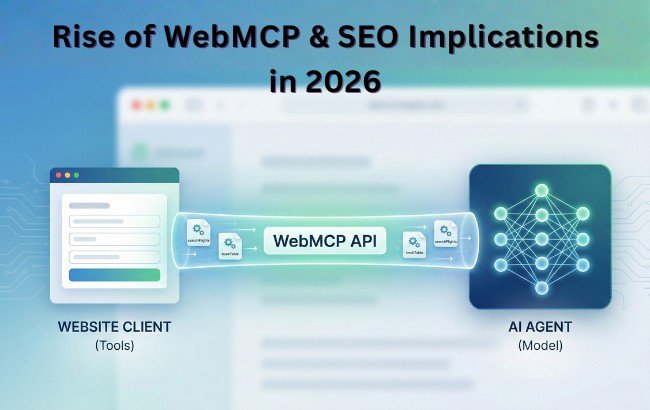
WebMCP stands for Model-Client-Protocol. It is a proposed browser API that standardizes how AI agents(such as Claude, Dia, Atlas, etc.) interact with web pages.
Instead of forcing AI models to blindly scrape HTML text or simulate human mouse clicks, WebMCP provides a structured framework for websites to expose their core functionalities as well-defined “tools.”
It establishes a universal language between your website’s interface and the AI agents built into modern browsers, such as Google Chrome, as well as standalone assistants like Atlas, Dia, and Claude Cowork.
At the heart of this protocol is a new JavaScript object accessible directly through the browser: window.navigator.modelContext.
This object acts as a secure bridge. When an AI agent visits a webpage, it no longer needs to guess what the page does. Instead, it queries the modelContext to ask, “What tools does this website offer?”
The website then responds with a structured list of capabilities, such as searchFlights, bookTable, or addToCart. It comes complete with natural-language descriptions and the exact parameters required to execute them.
This represents a massive paradigm shift in the task execution model.
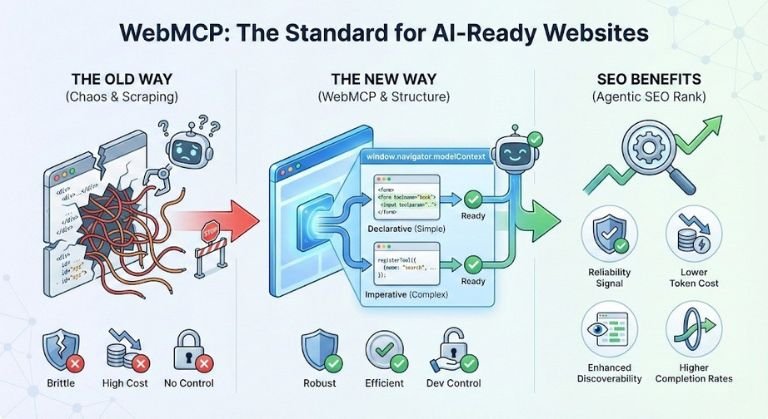
In the past, AI had to pull data from a site and attempt to reverse-engineer its purpose. Now, the website pushes its capabilities to the AI, creating a clear, stable, and reliable contract.
The AI agent becomes a capable co-pilot that understands exactly what your application can do. Thus, executing tasks instantly via JavaScript rather than fumbling through complex user interfaces.
Why WebMCP is Important for the SEO Landscape
SEO has always been about making your content easily discoverable and understandable by the target audience. It was primarily done through keywords, links, and technical structure.
But it’s simply not enough anymore!
Just like Google’s EEAT, the WebMCP is the newly sown seed of the current AI-based SEO industry.
With AI agents actively entering the ecosystem, search results have become dynamic, personalized, and task-oriented. WebMCP completely changes the game for the SEO landscape by shifting from passive crawling to interactive crawling.
Here are some titbits about WebMCP and SEO Implications of it:
- Well-Defined Structure for AI Agents: WebMCP allows you to clearly define how tools and content should be interpreted by AI. Instead of an AI agent just reading a page’s plain HTML text, WebMCP gives it a structured roadmap. If your site has a product database or a booking calendar, AI agents will know exactly how to navigate and extract those details. Thus, resulting in much more AI-readable content.
- Improved UX: Engagement metrics and bounce rates are one of the most important SEO signals that Google still prioritizes. WebMCP allows AI agents to interact with your site in ways that feel highly intuitive.
- Meeting the Enterprise Agent Boom: Gartner forecasts that by the end of 2026, 40% of enterprise applications will include task-specific AI agents. This is a massive leap from less than 5% in 2025. WebMCP provides the structured roadmap these agents need to navigate your site’s capabilities. Thus, ensuring your platform is agent-ready as corporate and consumer adoption skyrockets.
- Faster and Smarter Voice/Search Interaction: Voice search tools and AI assistants frequently struggle to provide accurate answers when websites lack clear context. WebMCP bridges this gap by giving structured signals that AI agents can use to answer complex queries faster and more accurately. This avoids the generic or incomplete responses users often complain about. Hence, resulting in a better Google SEO score.
- Combating the Zero-Click Reality: According to reports from Similarweb and Semrush, nearly 60% of all Google searches now end without a single click to an external website. WebMCP enables sites to thrive in this environment by prioritizing task execution (booking, buying, filtering) directly from the SERP or AI interface. This ensures you capture business value even if traditional WordPress website traffic declines.
How Website Owners Will Benefit from WebMCP SEO
Traditional bots, such as search engine crawlers, simply scan HTML, follow links, and index text.
However, AI agents equipped with WebMCP can actually ask questions to your site, execute tools, and use data much more intelligently than basic scraping.
For website owners, early adoption of this protocol brings several core benefits. Such as:
- Optimized for AI Interaction: Your website will yield more accurate AI responses to your content. Thus, ensuring your brand’s information is represented correctly when an AI assistant summarizes it.
- Improved User Engagement: By removing friction, AI helps users find exactly what they need faster. This keeps them engaged with your ecosystem rather than bouncing back to the search results.
- More Chance of Being Featured in AI-Based Searches: Implementing WebMCP significantly increases your website’s chances of appearing in AI-powered search results and AI overviews.
- Competitive Advantage: As with any major shift in search protocols, early adopters will naturally rank higher. They’ll also gain more visibility in emerging AI browser features compared to competitors relying on outdated HTML structures.
- Frictionless User Interaction: Users can complete specific tasks directly through an AI chatbot interface without having to click through your site’s standard funnel. It will dramatically boost your conversion rates.
Why is WebMCP Better Than the Previous Implementation?
To fully appreciate WebMCP, we must examine past implementations of AI web automation. This, until recently, relied on three highly flawed, brittle methods. WebMCP solves the critical issues inherent in all of them.
The Old Ways of Web Automation
HTML Parsing (Scraping): The AI downloads the entire DOM (Document Object Model) of a webpage and parses the massive text file to find input fields, buttons, and links based on CSS classes or IDs. It is akin to building a house using only a pile of raw materials and no blueprint.
Browser Automation Tools: Tools, such as Playwright or Selenium, enable AI to programmatically control a browser. The AI parses the HTML and then issues commands like find the element with ID ‘submit-btn’ and click it.
Vision Models: The AI takes a screenshot of the webpage and uses a vision model to visually identify where to click or type.
How WebMCP Resolves Old Issues
Eradicating Brittleness: The web is inherently dynamic. Developers constantly push updates, run A/B tests, alter CSS layouts, and change element IDs.
In the old system, a simple UI change, like renaming a button from Submit to Confirm, would instantly break an AI agent relying on DOM scraping or visual layout.
WebMCP completely abstracts the UI layer.
The AI doesn’t care if your date picker is a native HTML input, a complex React component, or a visual calendar. It only cares that the searchFlights tool requires a departureDate parameter.
Your UI can change daily, and the AI agent will continue to function flawlessly.
Drastic Improvements in Efficiency: Current AI web automation is incredibly resource-intensive. Sending an entire HTML document or a high-resolution screenshot to a Large Language Model (LLM) for every single step of a multi-page checkout process consumes a staggering number of tokens.
This translates to slow execution times, high API costs, and a massive environmental footprint.
WebMCP is radically efficient.
The AI simply reads a tiny JSON schema describing the tool, extracts the necessary parameters from the user’s prompt, and executes the tool in a single, concise interaction.
Providing Deep Context: An AI scraping a visual interface has no understanding of the underlying business logic. It doesn’t know that a specific dropdown triggers complex client-side validation, or that a date field strictly requires a YYYY-MM-DD format.
It is guessing based on superficial visual clues.
WebMCP allows developers to attach natural language descriptions to tools and parameters. The AI is explicitly told what that tool does, what data it expects, and how to format that data.
This eliminates hallucinated inputs and reduces error rates to near zero.
Restoring Developer Control: Perhaps the most significant flaw of the scraping era was the total loss of developer control. Website owners had no say in how external agents interacted with their infrastructure.
This led to server strain, corrupted analytics, and unintended application states.
WebMCP puts the power back in the developer’s hands. You decide exactly which functionalities to expose, what guardrails to put in place, and how the AI transitions through your application’s state.
Conclusion
WebMCP represents the maturation of the AI-integrated internet. As a result, it also represents the maturation of the SEO strategies.
For SEO in 2026, implementing WebMCP is no longer an experimental luxury; it is a baseline requirement. It ensures your site is robust, token-efficient, and perfectly positioned to thrive in the new, agent-driven landscape of web interaction.
That’s why we can’t ignore WebMCP and SEO Implecations of it in 2026.