

Unlike paid advertising, where you put a dollar in and immediately see clicks, SEO is a slow burn. It requires patience.
But patience does not mean flying blind. You need concrete evidence, not vague promises.
So, if you are asking how to know if your SEO is working, you have come to the right place. In this comprehensive guide, we will show you exactly which SEO metrics to look for, what tools to use, and what you can do to optimize it.
Let’s begin.
How to Know if Your SEO Is Working: 8 Key Signs
Before diving into the data, we have to set expectations. One of the most common questions business owners ask is, how long does it take for SEO strategies to work? The short answer: 3 to 6 months for initial movement, and 6 to 12 months for significant results.
By then, you should already see the effects by analyzing the lead indicators of working SEO.
Here’s how to know if your SEO is working:
1. Trend in Organic Traffic
The most definitive proof that your strategy is paying off is a steady upward trend in organic traffic.
This metric shows you exactly how many visitors are landing on your site from unpaid search engine results.
However, it is not just about raw numbers; it is about qualified growth.
A spike in traffic is great. But a sustained, upward-trending line indicates that search engines consistently trust your site as a reliable source for user queries.
2. Impressions and Clicks
Impressions represent the number of times your website appears in search results, even if the user scrolls right past it.
An increase in impressions is the very first heartbeat of a successful SEO campaign. It signals that Google has indexed your pages and is actively testing them in the search results.
As your rankings stabilize and climb, those impressions will inevitably turn into clicks.
When you look at your performance data and see both of these metrics rising in tandem, it is a clear indicator of SEO done right.
3. Entity Clarity
Entity clarity means that Google perfectly understands exactly who you are, what you do, and what topics you are an authority on.
If your SEO is working, you will notice your site ranking not just for one specific short-tail keyword, but for dozens of semantically related long-tail phrases surrounding that core topic.
When Google connects the dots between your brand, your services, and your industry expertise, it stops treating your pages as isolated articles. Then it starts treating your entire domain as a comprehensive, authoritative entity in your niche.
4. Click-Through Rates (CTR)
Ranking on the first page of Google is a massive achievement, but it is entirely useless if searchers do not actually click on your link. Your click-through rate is the ultimate measure of how compelling your search appearance is compared to your competitors.
If you are noticing an improving click-through rate across your key pages, it means your title tags and meta descriptions are highly relevant, deeply engaging, and perfectly matched to the user’s search intent.
A rising CTR also creates a positive feedback loop.
When Google sees users consistently choosing your link over others, it rewards you by pushing your ranking even higher.
5. Site Structure
A logical, well-organized site structure is the silent engine behind every successful strategy, whether you’re doing law firm SEO or dental SEO.
If your SEO is fundamentally sound, search engine crawlers can navigate your website effortlessly.
A working site structure relies on tight internal linking and clear content silos. Thus ensuring that link equity flows smoothly to your most important pages.
When your structure is optimized, you will find that newly published pages get indexed faster and rank higher right out of the gate. That’s because search engines can easily understand their context within your broader website hierarchy.
6. Backlink Relevancy
You know your off-page strategy is working when you start earning natural links from high-quality websites that are contextually related to your industry.
A single backlink from a respected industry publication or a highly relevant niche blog carries significantly more weight than dozens of links from random, spammy directories.
When your backlink profile grows with these contextually accurate links, it serves as a powerful endorsement to search engines.
7. Domain Authority
While Domain Authority (DA) is a third-party metric and not a direct Google ranking factor, it’s still a useful proxy for measuring overall SEO health.
This score predicts how likely your website is to rank in search engine result pages compared to your competitors.
If you are tracking your domain authority and see it slowly but surely ticking upward, it is a strong confirmation that your cumulative efforts are increasing your site’s overall SEO.
8. Tech Foundation
A brilliant piece of content will still fail if it is built on a crumbling technical foundation.
You know your technical SEO health check is passing when your site loads lightning-fast, features clean and efficient code, and passes Core Web Vitals assessments with flying colors.
A solid tech foundation ensures that search engines can crawl your site without wasting crawl budget on broken links, redirect chains, or bloated scripts.
Furthermore, ensuring your site is fully responsive is no longer just best practice; it is an absolute baseline requirement for keeping bounce rates low.
How to Fix Your SEO
If you want to dominate search results and prove your contextual authority to AI agents, follow these exact steps to optimize your digital footprint:
1. Secure Your Technical Foundation
Speed: Run your website through Google PageSpeed Insights. If the load time exceeds 3 seconds, then do this:
- Convert images to WebP format.
- Install a caching plugin to reduce server response times.
Furthermore, verify your site uses https://. If not, provision and force-redirect an SSL certificate via your domain registrar or hosting cPanel.
Pro tip: Use a markup generator to create LocalBusiness Schema (JSON-LD). Inject this code into your website’s <head> tag. That way, AI and search engines can read your business name, location, and operating hours.
2. Enforce Entity Consistency (The NAP Audit)
Search your exact firm name on Google. Check the first 10 results.
For instance, if your business appears as “Smith Law” in one place and “The Smith Law Firm” in another, you are diluting your entity authority.
To resolve this, create a master document with your exact Name, Address, and Phone number (NAP). Manually update your Google Business Profile (GBP), Bing Places, Apple Maps, and local directories to match this master record down to the punctuation.
3. Flatten Your Site Architecture
Ensure users and search engine crawlers can access your core service pages within two clicks from the homepage.
First, audit your top navigation menu. Link directly to individual service pages rather than burying them under generic dropdowns.
Now, add contextual internal links within your homepage body copy using exact-match anchor text (e.g., “view our SEO services” instead of “click here”).
4. Build Hyper-Relevant Backlinks
Plug your URL into a tool like Ahrefs or Moz. If your site is older than 2 years and your Domain Authority (DA) or Domain Rating (DR) is under 30, you need to build authority signals.
If you are thinking about acquiring bulk links from random directories, just don’t!
The best approach is to pitch for one contextual link from a highly trusted local entity. Sponsor a local business, join the regional Chamber of Commerce, or partner with a non-competitive site to earn a backlink that demonstrates real-world trust.
5. Align Content with Search Intent
Transition your copy from self-promotion to a solution-oriented approach.
Identify the primary questions your clients/audience ask. Add a dedicated FAQ section to the bottom of your service pages. Answer these questions directly and concisely.
Additionally, ensure your primary target phrase (e.g., “New York real estate agent”) appears in your H1 tag, your meta title, and naturally within the first 100 words of your body text without stuffing.
Track Your SEO with These Useful SEO Tools
Measuring success requires reliable data, not guesswork. The same goes for SEO performance analysis.
Now, you might be wondering: How do I measure SEO performance? You can track performance by isolating organic traffic, monitoring keyword positions, and analyzing user behavior using many useful SEO tools. Such as:
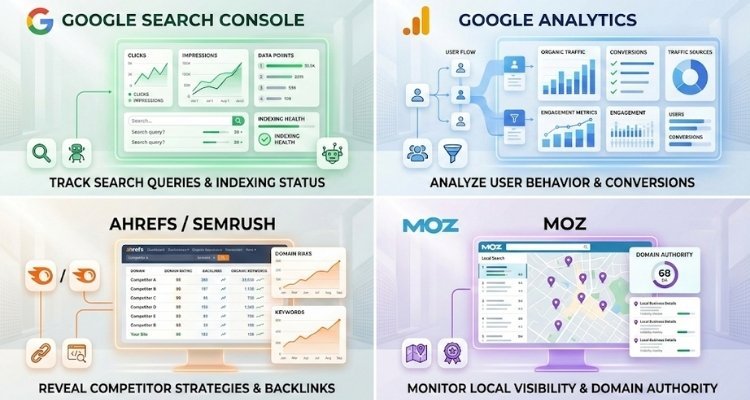
- Google Search Console: This is your direct line to Google. It highlights indexing issues and shows exactly which queries drive impressions and clicks.
- Google Analytics: If you are wondering how do I know if my keywords are working? They are working when they attract traffic that actually converts. GA tracks user behavior, engagement rates, and conversion paths once visitors land on your site.
- Ahrefs or Semrush: These premium tools are indispensable for competitive research. Semrush reveal competitors’ backlink profiles, track keyword movement, and identify content gaps you can exploit.
- Moz: This remains a highly effective tool, particularly for tracking local search visibility and benchmarking your domain authority against competitors.
By utilizing these platforms, you transform raw data into an actionable strategy.
FAQs
Can ChatGPT do an SEO audit?
No. ChatGPT is a fantastic assistant for on-page optimization, but it is not capable of an SEO audit. Because it cannot accurately diagnose deep technical issues, identify broken internal links across a massive site architecture, or provide real-time backlink data.
How to find out if SEO is really working for a company?
To determine whether your SEO is working for a company, check conversion tracking in Google Analytics. If organic search is driving a growing number of qualified leads or direct sales, the SEO is doing its job.
Is 70 a good SEO score?
An SEO score of 70 is generally considered very good, but it is entirely relative to your competition. Never look at these scores in a vacuum; use them strictly as a comparative benchmark.
What is the 80/20 rule for SEO?
The 80/20 rule (the Pareto Principle) applied to SEO means that 20% of your optimization efforts will generate 80% of your results.
Bottom Line
A well-optimized website doesn’t just grow out of nothing. It requires effort.
By monitoring your site’s SEO performance, you can clearly see whether you have a healthy website or not.
So stop obsessing over daily ranking fluctuations and start focusing on the long-term trends that actually drive your site’s growth.